
Pay per lead, commission or retainer: who carries the risk?
 By Victor van Hoorn PerezUpdated
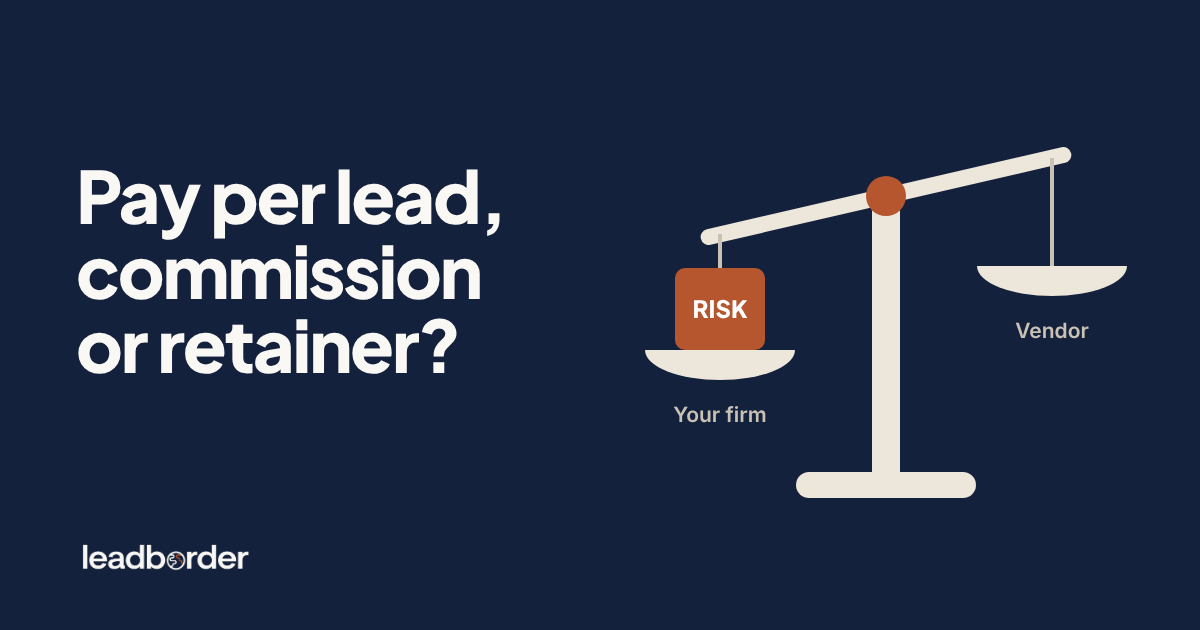
There are three common ways to pay someone to bring your firm new clients: a retainer, a commission or a price per lead. The difference between them is not only the price. It is who carries the risk when clients don't come.
I only sell per lead. I will explain why, but first, here is how the three compare.
What are the three models?
- Retainer. You pay an agency a fixed monthly fee to run your marketing. You pay for the work, whatever it brings.
- Commission. The vendor takes a share of your fee on every case that comes through them. You pay only when a client signs.
- Pay per lead. You pay a fixed price for each qualified lead. What happens after delivery is up to you.
Who carries the risk with a retainer?
The firm. You pay every month, whether the ads bring ten good clients or none.
That is not always bad. A good agency builds assets that belong to you: your own brand, your website, your ad account and everything it learns. If you want to own your marketing for the long term, a retainer can make sense.
But you need budget and patience. And you carry the cost of every test that doesn't work.
Who carries the risk with commission?
Mostly the vendor, at first. That is why commission sounds like the safest option.
Look closer, though. The vendor now has a share in your client relationship. To get paid, they need to know which clients signed and for how much, so they need a view into your files. It also opens the door to disputes about who brought which client. And on a good case, you give away part of a fee you earned with your own work.
There is also a rules question. In many places, sharing legal fees with someone who is not a lawyer is restricted. Before you agree to any share of your fees, check with your bar association.
Who carries the risk with pay per lead?
Both sides carry part of it.
The vendor pays for the ads and for every person who doesn't pass the checks. That part is bigger than most firms think, because many of the people who respond to an immigration ad are not ready or not a fit. The vendor carries that cost. The firm doesn't pay for them.
The firm pays for each qualified lead and does the work of turning it into a client. You know exactly what each lead costs, and you keep your whole fee.
Why do we only sell per lead?
A few reasons.
Your fee stays yours. We never take a share of a case. What you charge your client is between you and your client.
We don't need your files. We don't track your clients' payments or ask what each case was worth.
Our job stays clear. We focus on one thing: bringing you people who are real, reachable and serious about their case. You focus on signing them.
You can compare us. A fixed price per lead lets you work out your cost per signed case and compare it with any other source you use.
What should you ask before you sign with any vendor?
Whatever the model, a few questions show you what you are really buying:
- What makes a lead qualified? Ask for the exact checks, not "pre-qualified".
- Is every lead exclusive? If a lead goes to several firms, you are racing them to the phone.
- How is the phone number checked? A verified number means you can reach the person.
- How and how fast are leads delivered? By email, to your CRM, or both, and within how long.
- What exactly do you pay for? A fixed price per lead, a monthly fee or a share of fees, and for how long.
Good vendors answer these quickly and in writing. If the answers stay vague, the leads usually are too.
How do you compare the models fairly?
Bring them back to the same number: what each signed case cost you. For a retainer, divide the fees you paid by the cases it brought in. For pay per lead, divide what you paid for leads by the cases they became. For commission, the cost is the share you gave away on each case.
Measure over the same period, and give every model the same follow-up from your side. Otherwise you are comparing your own effort, not the model.
When does each model fit?
- A retainer fits if you want to build your own brand for the long term and have the budget to wait for results.
- Commission rarely fits a law firm, because of the fee-sharing rules and the access it needs to your client files.
- Pay per lead fits if you want a steady flow of new people now, can call them back fast and are ready to do the follow-up.
Whichever you pick, judge it the same way: by what each signed case cost you, measured over months.
Frequently asked questions
Can a law firm pay a commission on its fees?
It depends on the rules where you practice. In many places, sharing legal fees with someone who is not a lawyer is restricted. Check with your bar association before you sign anything based on a share of fees.
What does qualified mean in pay per lead?
It should mean the lead passed checks that matter for your cases: real contact details, the basic requirements of the case, the timing and a wish for professional help. Ask the vendor for the exact list.
Can we combine models?
Yes. Some firms pay an agency to build their own brand over time and buy leads for steady volume now. Keep the sources separate so you can measure each one.
What if the leads don't sign?
Look at the full path first: how fast leads were called, how long follow-up lasted and how consults went. Then compare the cost per signed case with your other sources over several months.
Read next
Want more immigration clients?
A few quick questions about your firm. It takes less than a minute, and we’ll get back to you personally.
Talk to usWritten by
Victor van Hoorn Perez
Victor runs Leadborder, which generates qualified immigration leads for law firms through its own immigration brands.